
Choosing commercial rooftop solar panels is more complicated than comparing wattage on a product page. A rooftop project must balance module efficiency, available roof area, structural loading, temperature behavior, warranty terms, supply continuity, installation support, and the needs of the building itself. The “best” panel for a warehouse may not be the best choice for a factory with weight restrictions or a multi-site commercial portfolio. This guide evaluates four relevant brands and suppliers using their published company and product information, with particular attention to commercial applications, technology, procurement, and project fit. Because the list includes both manufacturers and a specialist solar distributor, buyers should distinguish between panel manufacturing capability and system-supply services before requesting quotations.
Full List of the Top 4 Commercial Rooftop Solar Panel Brands
- Jinkosolar — Broad commercial module portfolio and large-scale project suitability.
- Mission Solar Energy — U.S.-based module production with N-type and bifacial options.
- Solar Electric Supply — Commercial solar equipment sourcing, kits, storage, and project support.
- Apollo Power — Flexible solar technology for applications where conventional rigid modules may be unsuitable.
Comparison Table
| Brand | Key Products | Key Features | Best For |
|---|---|---|---|
| Jinkosolar | Commercial and utility-scale crystalline-silicon module families, including n-type product lines | High-power module options, n-type technology in selected products, broad international project experience, and established manufacturer-scale supply | Large commercial rooftops, industrial facilities, and projects requiring a mainstream global module supplier |
| Mission Solar Energy | MSH10 N-Type Bifacial 144HC Dual Glass; N-Type 108HC monofacial module | N-type TOPCon technology, high-density interconnects, multi-busbar design, bifacial generation, and published long-term warranty options | Commercial and industrial rooftops, especially projects prioritizing U.S.-based engineering and supply-chain considerations |
| Solar Electric Supply | Complete grid-tied solar kits, battery storage, mounting systems, and commercial solar equipment | Wholesale pricing, system design support, dealer-oriented purchasing, multi-site procurement, and off-grid or storage configurations | Installers, contractors, and commercial buyers seeking system components rather than a single panel manufacturer |
| Apollo Power | Flexible solar solutions for C&I roofing, awnings, vehicles, and specialized surfaces | Patented flexible-cell technology, lightweight construction, and suitability for applications where rigid panels may present design or weight limitations | Lightweight commercial roofs, curved or unconventional surfaces, awnings, vehicles, and specialized installations |
Detailed Reviews
1. Jinkosolar
Overview
Jinkosolar is a major global photovoltaic manufacturer serving residential, commercial, and utility-scale markets through a portfolio of crystalline-silicon solar modules. Its official website presents module products, company information, sustainability material, and support resources for international customers. The company is particularly relevant to commercial rooftop projects because its product range is aimed at scalable photovoltaic deployments, where module power, system design, bankability, logistics, and long-term operating performance all affect the project economics.

Jinkosolar’s current product information includes n-type module technology in selected product families, including TOPCon-based products. N-type cell platforms are generally used by module manufacturers to pursue higher conversion efficiency and improved long-term energy retention compared with older cell architectures, although the exact performance, dimensions, mechanical ratings, and warranty conditions depend on the specific model and regional datasheet. Commercial buyers should therefore compare the precise product document supplied for the intended market rather than relying only on a family name.
Products, Materials, and Technology
Jinkosolar’s commercial relevance comes from its focus on standard framed crystalline-silicon modules that can be integrated with common rooftop mounting and inverter systems. Depending on the selected series, buyers may encounter monofacial or bifacial configurations, different cell layouts, various module power classes, and different mechanical-load ratings. The suitability of any particular module depends on roof orientation, ballast or attachment method, wind and snow loads, fire requirements, available maintenance access, and the electrical design of the array.
Selected Jinkosolar n-type products use TOPCon cell technology and multi-busbar interconnection approaches. These technologies are intended to improve electrical collection and module output while supporting the high-power formats used in modern commercial and utility installations. Some products are also designed for bifacial generation, which can provide additional rear-side energy when the roof surface, mounting height, albedo, and array geometry allow useful reflected light. On a conventional low-clearance rooftop, the real bifacial gain may be more limited than in an open-ground installation, so the project model should use site-specific assumptions.
Material and construction details must be checked in the applicable datasheet and installation manual. Important points include the glass configuration, frame design, junction-box rating, connector compatibility, maximum system voltage, operating-temperature range, permissible mounting zones, and mechanical-load limits. These details are more useful for engineering decisions than a headline wattage alone.
Market and Business Scope
Jinkosolar operates as a module manufacturer rather than simply a marketplace or equipment reseller. Its international presence and broad product offering make it suitable for developers, EPC contractors, distributors, commercial building owners, and utility-scale project teams. For a multi-building rooftop program, a manufacturer with several module formats can help standardize procurement while still allowing the EPC to select a model that fits different roof areas or structural conditions.
Commercial customers should still verify local availability, authorized distribution, delivery schedules, import requirements, warranty jurisdiction, and after-sales procedures. A globally recognized manufacturer does not remove the need to confirm who will provide field support and how warranty claims will be handled in the project’s country.
Pros / Key Features
- Broad manufacturer-scale product coverage for commercial and utility applications.
- Selected module families use n-type and TOPCon cell technology.
- High-power module formats can help reduce the number of modules, mounting points, and electrical connections required for a given system size.
- Monofacial and bifacial product choices may support different rooftop designs.
- Suitable for structured procurement programs where consistency across multiple sites is important.
- Official product documentation allows engineers to verify electrical and mechanical parameters before specification.
Use Cases / Best For
Jinkosolar is best suited to large commercial rooftops, factories, logistics centers, warehouses, and industrial facilities where a conventional rigid module is appropriate and the buyer wants a mainstream global manufacturer. It is also a practical starting point for EPCs comparing high-power n-type modules for projects with limited roof area.
The final choice should be based on the exact Jinkosolar model, not the brand name alone. A high-output module may reduce module count, but its larger dimensions or higher weight could complicate roof access, structural engineering, or replacement work. Buyers should request the current regional datasheet, product warranty, performance warranty, certification documents, and authorized-channel information before purchase.
2. Mission Solar Energy
Overview
Mission Solar Energy states that it was founded in 2014 and operates from San Antonio, Texas. The company describes itself as a U.S.-based producer of solar modules serving residential, commercial, and utility-scale markets. Its published positioning emphasizes engineering, quality control, domestic workforce development, and an ethical supply chain. Mission Solar Energy is a subsidiary of OCI Holdings, according to the company’s published information.
Products, Materials, and Technology
The company identifies the MSH10 N-Type Bifacial 144HC Dual Glass module as a solution for commercial and industrial applications. Published information describes the module as using N-type and SMBB technology and offering up to 590 W of front-side output. The dual-glass bifacial format is intended to collect light from both sides, although actual rear-side production depends on roof reflectivity, array elevation, spacing, and site conditions.
Mission Solar Energy also identifies the N-Type 108HC as a monofacial module engineered in the United States for residential and commercial rooftop installations. The company’s published product information references high-density interconnects, multi-busbar design, and N-type TOPCon technology. Warranty terms vary by product and document; the company’s material references 25-year product and power warranty coverage for one product presentation and a 30-year performance warranty for another. Buyers should confirm the exact warranty applicable to the selected model and sales region.
Market and Business Scope
Mission Solar Energy serves installers, developers, homeowners, and commercial or industrial project owners. Its San Antonio operations are presented as supporting quality oversight, delivery, and service for American installers, EPCs, and businesses. The company also emphasizes compliance policies relating to the Uyghur Forced Labor Prevention Act and states that forced labor is prohibited in its supply chain.
Pros / Key Features
- U.S.-based company with operations in San Antonio, Texas.
- N-type, TOPCon, multi-busbar, and high-density interconnect technologies in identified product materials.
- MSH10 bifacial dual-glass module aimed at commercial and industrial applications.
- Published warranty information for selected product lines.
- Company-stated focus on ethical sourcing and supply-chain oversight.
- Local operations may be relevant to U.S. projects prioritizing domestic support and delivery.
Use Cases / Best For
Mission Solar Energy is a strong candidate for U.S. commercial and industrial rooftops, particularly when domestic engineering, U.S. operations, and supply-chain documentation are important procurement criteria. Its bifacial dual-glass product may be considered for rooftops where the layout and surface conditions can produce meaningful rear-side irradiance.
3. Solar Electric Supply
Overview
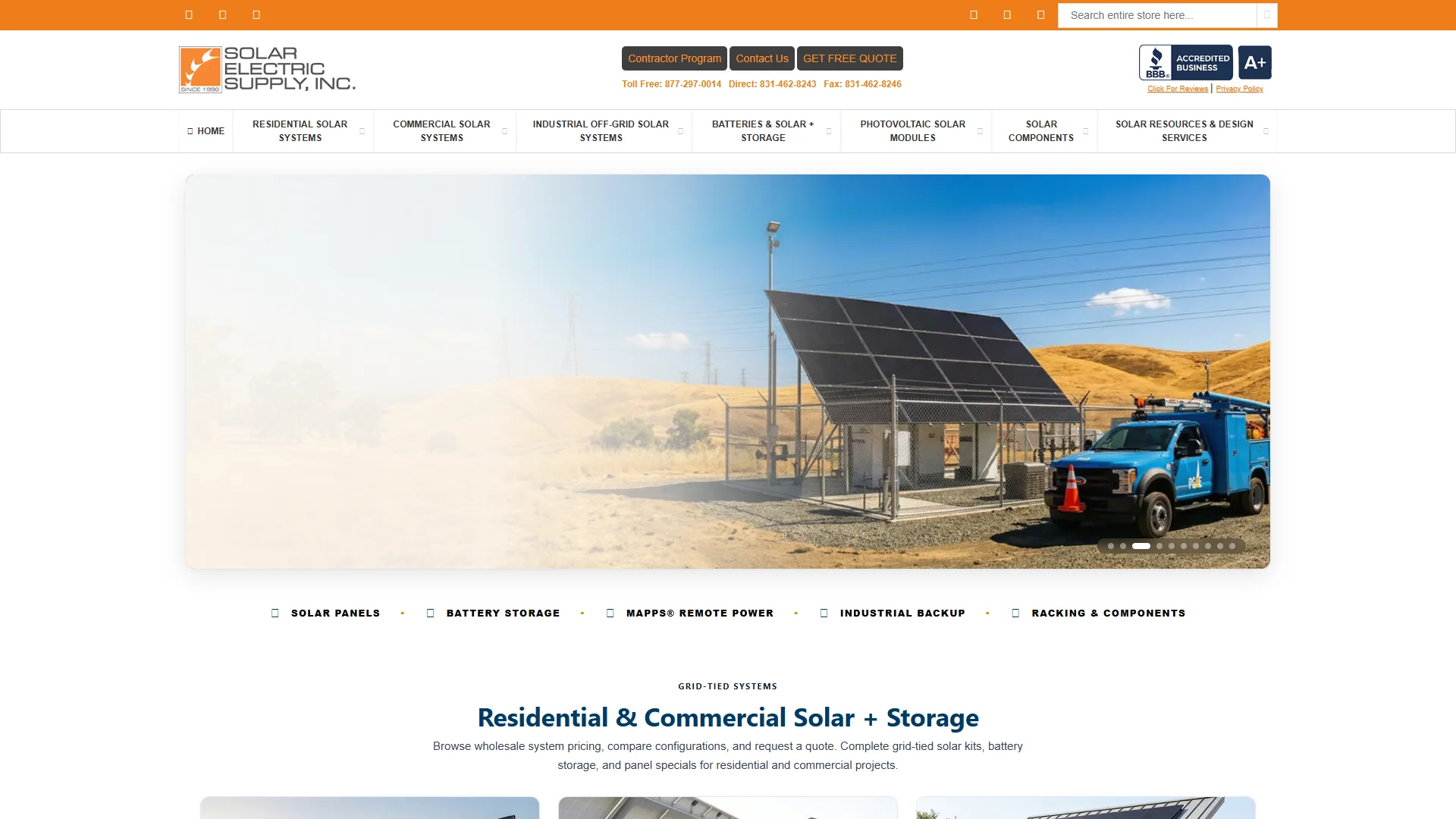
Solar Electric Supply is presented as a solar equipment supplier rather than a dedicated solar-module manufacturer. Its website provides commercial and residential solar equipment, complete grid-tied kits, battery storage products, mounting systems, and specialized solutions. The company also promotes wholesale pricing, dealer support, and project assistance.
Products, Materials, and Technology
The company’s offerings include pre-configured solar kits, mounting systems for residential and commercial use, battery storage, and equipment for specialized infrastructure. Published information references commercial and residential solar-plus-storage solutions, multi-site procurement, BESS solutions, and engineered off-grid systems. It also lists specialized solar power applications for areas such as telecom, monitoring, obstruction lighting, and critical infrastructure.
Because Solar Electric Supply distributes equipment from multiple manufacturers, panel materials, cell technology, power ratings, warranties, and certifications depend on the specific module selected from its catalog. Buyers should request the original manufacturer datasheet and warranty documents for each proposed panel rather than treating the distributor as the panel producer.
Market and Business Scope
Solar Electric Supply’s stated customer groups include solar contractors, dealers, businesses, and customers purchasing residential or commercial systems. Its wholesale and project-support model can be useful when a buyer needs multiple components from one source, including modules, inverters, batteries, racking, and balance-of-system equipment.
Pros / Key Features
- Commercial and residential equipment sourcing through one supplier.
- Wholesale pricing and dealer-oriented purchasing support.
- Pre-configured kits and free system-design assistance are promoted on the company’s website.
- Product scope includes solar-plus-storage, off-grid, and specialized infrastructure applications.
- Can support procurement where equipment coordination is more important than selecting one panel brand.
Use Cases / Best For
Solar Electric Supply is best for installers, contractors, and commercial buyers who need system components, procurement assistance, or complete configurations. It may be particularly useful for smaller commercial projects, storage-integrated systems, remote infrastructure, or buyers comparing several manufacturers through a single supply channel. The project owner should verify product availability, lead times, system compatibility, and the identity of the original panel manufacturer before placing an order.
4. Apollo Power
Overview
Apollo Power describes itself as a flexible solar manufacturer established in 2014. Its published positioning centers on patented flexible-cell technology and applications in automotive, defense, awnings, and commercial and industrial roofing. This places Apollo Power in a different category from conventional rigid crystalline-silicon panel suppliers.

Products, Materials, and Technology
Apollo Power’s principal differentiator is its fully flexible solar technology. Flexible modules can be considered where roof shape, surface curvature, weight limitations, or installation constraints make conventional framed modules difficult to use. The company also describes applications involving embedded solar cells in vehicle surfaces and other specialized structures.
The available company material does not provide enough detail to make a general claim about a single standardized commercial rooftop module specification. Buyers should request model-specific information covering rated output, efficiency, roof attachment method, fire classification, wind resistance, hail performance, operating temperature, expected service life, electrical connectors, inverter compatibility, and warranty coverage.
Market and Business Scope
Apollo Power’s stated markets include automotive, defense, awnings, and C&I roofing. The company also publishes examples involving commercial and municipal applications. Its flexible approach may help address projects that require a non-standard form factor or low-weight installation, but the engineering assessment must account for the roof membrane, adhesive or mechanical attachment, maintenance access, and replacement procedures.
Pros / Key Features
- Flexible-cell technology for applications beyond conventional rigid-panel layouts.
- Potentially relevant to lightweight, curved, integrated, or space-constrained surfaces.
- Published experience across commercial roofing, awnings, vehicles, and specialized markets.
- Can offer an alternative when roof geometry or structural limits restrict standard modules.
Use Cases / Best For
Apollo Power is best considered for lightweight commercial roofs, curved surfaces, awnings, vehicles, and specialized installations where flexibility is a primary design requirement. It is less directly comparable with high-power rigid modules used on large, structurally capable warehouses. A qualified engineer should verify roof compatibility and local building-code requirements before specifying a flexible product.
How to Choose Commercial Rooftop Solar Panels
1. Match the Module to the Roof
Start with a structural and roofing assessment. Confirm the roof’s remaining service life, allowable loading, attachment zones, wind exposure, drainage paths, and maintenance requirements. A high-wattage module is not automatically the best option if its dimensions or weight create structural or access problems.
2. Compare Efficiency and Total Installed Cost
Efficiency matters most when roof area is limited. However, module price is only one part of the system cost. Compare the total installed cost, including racking, labor, wiring, inverters, optimizers where applicable, roof reinforcement, and maintenance access. A slightly lower-efficiency panel may be economically reasonable on a large roof with abundant usable space.
3. Review Cell Technology and Bifacial Suitability
N-type TOPCon and other newer cell architectures can offer strong output and long-term performance, but the exact benefits depend on the model and site. Bifacial panels require suitable rear-side illumination. Low-clearance arrays on dark roofs may achieve less bifacial gain than elevated systems over reflective surfaces.
4. Check Electrical Compatibility
Compare module open-circuit voltage, operating voltage, current, temperature coefficients, maximum system voltage, and connector type with the proposed inverter and system design. High-current modules may require particular inverter input characteristics and cable sizing. The EPC should complete string calculations for the coldest and hottest expected conditions.
5. Verify Warranty and Bankability
Review both the product warranty and the power or performance warranty. Confirm the warranty provider, exclusions, claim process, applicable jurisdiction, authorized sales channel, and whether labor or shipping is covered. For a commercial project expected to operate for decades, the manufacturer’s service history and financial continuity are also relevant risk factors.
6. Consider Supply Chain and Delivery
Commercial schedules can be affected by manufacturing allocation, port delays, customs requirements, distributor inventory, and product discontinuation. Ask for a written quotation that identifies the exact model, delivery location, quantity, production status, packaging, replacement policy, and expected delivery date.
7. Examine Certifications and Local Compliance
Confirm that the selected module is certified for the intended country and installation type. Depending on the jurisdiction, this may include electrical safety, fire classification, building-code, hail, wind, snow, and environmental requirements. Certification should be verified from current manufacturer documentation and the authority having jurisdiction.
8. Evaluate the Supplier’s Project Support
For large rooftops, technical documentation and responsive support can be as important as the panel’s rated output. Ask whether the supplier provides layout assistance, installation manuals, training, replacement procedures, serial-number tracking, and warranty support. Distributors can be useful for coordinating equipment, while direct manufacturers may offer broader product documentation and project resources.
Final Verdict
Jinkosolar ranks first for commercial rooftop projects that need a mainstream global module manufacturer, scalable product selection, and access to modern n-type module technology. It is particularly suitable for large warehouses, factories, and multi-site commercial programs, provided the exact model is checked against structural, electrical, warranty, and local compliance requirements.
Mission Solar Energy is a notable alternative for U.S. commercial and industrial projects that value San Antonio-based operations, N-type technology, bifacial dual-glass options, and supply-chain documentation. Solar Electric Supply is better understood as a procurement and equipment partner, useful when a project needs kits, storage, mounting, and other system components. Apollo Power occupies a specialist position, with flexible products aimed at lightweight, curved, integrated, or unconventional commercial surfaces. The most appropriate choice depends on the roof, project objectives, procurement requirements, and verified model-level documentation.
FAQs
Are high-wattage panels always the best choice for a commercial roof?
No. High-wattage panels can reduce module count, but they may also be larger or heavier. The best choice must fit the roof structure, available area, mounting design, inverter configuration, access requirements, and local regulations.
Are bifacial panels suitable for every commercial rooftop?
No. Bifacial output depends on rear-side light exposure, roof reflectivity, mounting height, row spacing, and array geometry. A low-mounted array on a dark roof may provide limited additional rear-side generation, so the expected gain should be modeled for the specific site.
What documents should a commercial buyer request before ordering?
The buyer should request the current model datasheet, installation manual, product and performance warranties, certification records, mechanical-load information, connector details, temperature coefficients, availability confirmation, and written delivery terms. The project team should also verify the supplier’s warranty and after-sales process.